Members from Tamil Heritage Foundation, (Subashini from Germany), Ponniyin Selvan Yahoo group, REACH, temple_cleaners yahoo group and Madame Deborah Thiagarajan the owner of Dakshin Chitra were among the distinguished, varied members who took part in the heritage trip.
Saturday, June 26, 2010
Modern history to cave man site - A trip within Chennai-19th June 2010
REACH FOUNDATION conducted a heritage trip from Kundrathur to MahaNyam, Malayapattu Village off the Kundrathur- Sriperumbudur road, which leads you to Manimangalam -Tambaram. From the Mandap on the yesteryears Rajapattai to the burial sites in the MahaNyam and Malayapattu villages, we had a heady cocktail of history, paleolithic, cave man, Chola, Nayaka, late 19th century Mudaliars and a dilapidated Choal period gajabrushta shrine unattended in Kundrathur, finally ending atSomangalam, one of the Thondai Mandala Navagrahasthalas.


Sunday, June 20, 2010
Tamil Heritage wardens meet on 20th June 2010
Sundar Bharadwaj @ SPS (Siva Pada Sekaran) of Ponniyin Selvan Varalatru Peravai (PSVP) conducted a get together for all like minded personalities from India and abroad before the scholars leaving for the Coimbatore conference conducted by the Tamilnadu government. Many issues not really covered by the symposiums and such conferences - digitization and bringing all Tamil heritage related publications and available documents, voices, videos under one umbrella by Tamil Heritage Foundation, the built heritage conservators and those who take the temple architecture and its art appreciation and inscriptions to common man - REACH Foundation, Professor Swaminathan and NHM (New Horizon Media) and Kizakku Padippagam media man Badri's Tamil heritage forum, Prakrithi foundation, Indian Science monitor Mr. TKV Rajan, Historian Dr Chitra Madhavan, Project Madurai fame Dr. Kalyan, ASI archaeologist P.S. Sriraman, Sidda heritage practitioners, Siddars, and heritage lovers met together for a brain storming and discussing strategies of how to bring our efforts in an united manner and build synergy. The introduction of all groups were fantastic and Ponniyin Selvan had been the inspiration and this story has made many realities work, like Poetry in stone run by Vijay and his team, REACH foundation initially started by bunch of youths later guided to form a foundation headed by renowned archaeologist Dr T Satymurthy. It is he who worked on Adichanallur the most ancient site of Tamil culture so far unearthed, the Sangam age Murugan temple near Tiger caves on the Mamallapuram road and now bringing out the most ancient Pallava temple at Vepathur near Kumbakonam. Ironically such scholars were not even invited by the Tamil Semmozhi conference is a different subject to discuss and this is this blogger Chandra's personal view, not to offend anyone concerned), and to top it the THF founders Dr N. Kannan and Subashini Tremmel who were present and shared their vision to the heritage wardens of Chennai. The Sidda medical Palm leaf donors spoke on the ancient science and medicine, their values and the unfold secrets now getting digitized to usher a new light on the world's oldest and time tested medicine of Tamil land. A Siddar himself presented himself in this forum today and showered his blessings for all the voluntary work being done by the above said groups. Any omission in this fast news flash of the function which just happened this morning, is not intentional and those attended and who are missed out may bring this to our notice by emailing to reach.aasai@gmail.com
The pictures are here for you to see
Wednesday, June 09, 2010
REACH Founder speaking on Kalahasti tower
Noted Archealogist Dr Sathyamoorthy explains Temple Tower Collapses-Interview in www.vhtv.in
content bank direct view links are as follows
Pls see and comment
Friday, May 07, 2010
Inscription learning -certificates issuing function
An excellent summary of the function has been reported by our trustee and moderator of Ponniyin Selvan Yahoo groups, Shri. Sundhar Bharadwaj @ Sivapatha sekaran -SPS:
Dear Friends,
Certificates for those "students" who completed EPIGRAPHY reading course were
distrubted by Hon'ble Minister Thangam Thennarasu. Lakshmi Machine Tools Gp CBT
Mr. Ravi Sam presided over. Dr. Sathyamurthy and Dr. Rajvelu rendered speeches
on the subject.
From our side Natarajan, Plastic Chandra took part in event management.
Nandakumar Selvaraj attended.
Minister experessed his happiness in attending this meet and distributing the
Certificates.
Apart from sharing all our concern of creating awareness to protect the
monuments, he shared his responsibility and readiness in guiding us to put this
into action and commended the efforts of REACH on special areas.
He Observed: Somehow OUR Forefathers preserved these Cultural Assets and passed
on to us in spite of several invasions and challenges by way of external
Cultures all these period exceeding about 10 centuries ...
How can we permit these to be perished right in front of our Own eyes - in this
21st Century - when we claim that our Technology is superior and resources are
much better than the past ?
That was a soul-searching Speech by the Hon'ble Minister.
Then on the lighter note, he too enjoyed recalling his reading Ponniyinselvan
and discussing with his friends during his (Annamalai) University days in
Chidambaram (in early 80s).
He also recalled of having visited Udayarkudi - searched for Ravidasan
inscriptions etc..
He also recalled of having gone through Thiruvalangadu Copper Plates .. and
observed on Uthama being mentioned very less...!!
And commended the activities of PS group as well in creating more awareness
among the youth !
Also observed re threat to some cultural asset :: It was brought to his
attention and immediately reached CM almost at midnight - who in turn - called
the concered Authority and ensured the threat (by negiligence) was moved away.
And our long time dream - much discussed HERITAGE CLUB in SCHOOLs - is being
putforth in the Assembly session for allocation of funds !!
We - PS - REACH - AASAI - all thanked the Minister for all his support.
We will discuss and invite the Honble Minister for our PS MEET after the
Chemmozhi manadu !
sps
Photos of certificate function-06-05-2010 taken by REACH Chandra@ Plasticschandra
Dear Friends,
Certificates for those "students" who completed EPIGRAPHY reading course were
distrubted by Hon'ble Minister Thangam Thennarasu. Lakshmi Machine Tools Gp CBT
Mr. Ravi Sam presided over. Dr. Sathyamurthy and Dr. Rajvelu rendered speeches
on the subject.
From our side Natarajan, Plastic Chandra took part in event management.
Nandakumar Selvaraj attended.
Minister experessed his happiness in attending this meet and distributing the
Certificates.
Apart from sharing all our concern of creating awareness to protect the
monuments, he shared his responsibility and readiness in guiding us to put this
into action and commended the efforts of REACH on special areas.
He Observed: Somehow OUR Forefathers preserved these Cultural Assets and passed
on to us in spite of several invasions and challenges by way of external
Cultures all these period exceeding about 10 centuries ...
How can we permit these to be perished right in front of our Own eyes - in this
21st Century - when we claim that our Technology is superior and resources are
much better than the past ?
That was a soul-searching Speech by the Hon'ble Minister.
Then on the lighter note, he too enjoyed recalling his reading Ponniyinselvan
and discussing with his friends during his (Annamalai) University days in
Chidambaram (in early 80s).
He also recalled of having visited Udayarkudi - searched for Ravidasan
inscriptions etc..
He also recalled of having gone through Thiruvalangadu Copper Plates .. and
observed on Uthama being mentioned very less...!!
And commended the activities of PS group as well in creating more awareness
among the youth !
Also observed re threat to some cultural asset :: It was brought to his
attention and immediately reached CM almost at midnight - who in turn - called
the concered Authority and ensured the threat (by negiligence) was moved away.
And our long time dream - much discussed HERITAGE CLUB in SCHOOLs - is being
putforth in the Assembly session for allocation of funds !!
We - PS - REACH - AASAI - all thanked the Minister for all his support.
We will discuss and invite the Honble Minister for our PS MEET after the
Chemmozhi manadu !
sps
Photos of certificate function-06-05-2010 taken by REACH Chandra@ Plasticschandra
I request student Siddarth C to share the photos of students he had taken, so that it can be memorable for the students concerned.
Protection of monuments
s - Talk by Minister Thangam Thennarasu in certificate issuing function on 6-5-2010
Better Laws for protecting the whole hillock having brahmi letters
Friday, March 12, 2010
Field trip of second batch of epigraphy students to Thirumukoodal


Mr. L V Krishnan, a retired Scientist was one of our second batch of students and he had made an excellent report of the trip we conducted for the epigraphy students on 17th January 2010.
Thank you Mr. Krishnan! we need more volunteers to write on various heritage issues and such findings, tarvelogues etc.
REACH Team.
================================================
Report on a Field Trip of the Second Epigraphy Batch organized on Jan 17, 2010
About ten persons from the second batch of the epigraphy course run by AASAI/REACH Foundation went on a field trip to the Thirumukkudal temple on January 17, 2010 to read some of the inscriptions with the help of the guru Sri Ramachandran. Dr. Sathyamurthy was also present with his geologist friend.
The temple and the inscriptions that fill practically the entire surface of its walls are remarkably well preserved. It was possible to read the inscriptions directly without the need for estampaging.
We began by reading the inscription found on the முப்பட்டைக்குமுதம் of the outer surface of the south wall that begins with இராசேந்திரசோழன் மெய்கீர்த்தி as given below (text no. 1). We then went on to read the inscription about the hospital found on the eastern part of the front wall on the north, which may also be found below (text no. 2). The pillar of a recently added structure was too close to the wall and covered some part of this inscription.
Though there are references to hospitals and institutions for teaching medical sciences in ancient
We also attempted to read some inscription on the inner face of the southern outer wall (behind the garbagriham) that seems to relate to a grant to the temple priest for keeping a lamp burning. The reading had to be done with the help of a torch as there was no power and no light in the area. The part that was read is also given below (text no.3).
It was about one in the afternoon when we completed reading of the inscriptions. We were hungry but the
We then went on to the Sundaravarada temple in Uttaramerur. The route we were advised to take turned out to be rather long, but when we reached the temple, we were provided delicious prasadam in the form of chakkarapongal, puliodarai and dadhyodhanam. The temple is unique in having three garbagrihams one above another. After visiting the temple we went on to the Kailasanathar temple being renovated by REACH and found the work progressing well.
Inscriptions as read
Text no. 1
இராசேந்திரசோழன் மெய்கீர்த்தி
திருமன்னிவளர இருநிலமடந்தையும் போர்செயற் பாவையுஞ்சீர்தனிச்செல்வியும் தன்பெரும் தேவியராகி இன்புற நெடுதியலூழியுன் இடைதுறைநாடும் தொடர் வனவேலி பிடர்வனவாசியும் சுள்ளிச்சூழ்மதிய் கொள்ளிப்பாக்கையும் நண்ணற்கு அருமுரண் மண்ணைக்கடக்கமும் பொருகடல்மீழி முத்தரையர் தம் முடியும் ஆங்கவர்தேவியர் ஓங்கெழில்முடியும் முன்னவர் பக்கல் தென்னவர் வைத்த சுந்தரமுடியும் இந்திரன் ஆரமும் தெண்டிரல் ஈழமண்டலமுழுவதும் எறிபடைக்கேரளர் முறைமையிற்சூடும் குலதனமாகிய பலர் புகழ் முடியுஞ்சேர் செங்கதிர்பாலையுஞ்சங்கதிர்வேலை தொல்பெருங்காவல் பல்பழந்தீவுஞ்செருவிற்சினவி இருபத்தொருகால் அரசு களைகட்ட பரசுராமன்மேவரும் சாந்திமற்றீவரண் கருதி இருத்திய திருந்தகமுடியும் பயங்கொடு பழிமிக முயங்கியில் ஒதுகிட்டு ஒளிந்த செயசிங்கன் அளப்பரும் புகழொடும் பீடியில் இரட்டபாடி ஏழரையிலக்கமும் நவநிதிக்குலப்பெருமலைகளும் விக்கிரம சக்கரக்கோட்ட முதிர்பட வல்லை மதுரை மண்டலமும் கரமிடை வளைய் நாமிணைக்கோணையும் வெஞ்சிலவீரர் பஞ்சப்பள்ளியும் பாசுடைபணைய மாசுடைதேசமும் அயர்வி வெண்கீர்த்தியாதிநகர் அவையில் சந்த்ரிரன் தொல்குலத்து இந்திரரதனுந்தன் விளையரர்களத்து கிளையொடும்பிடித்து வலத்தொடு குலதனக்குவையும் கட்டரண் செறிமிளை ஒட்டவிஷியமும் பூசுரர்சேய்நல் கோசலை நாடும் தன்மபாலனை வெம்முனையழித்து வண்டுறைச்சாலை தண்டபுத்தியும் ....
Text no. 2
ஆதுரசாலை வீரசோழனில் வியாதிப்பட்டு கிடப்பார் பதினைவர்க்கு பேரால் அரிசி நாழியாக அரிசி குறுணி எழுநாழிக்கு நெல் தூணி ஐந்நாழி உரியும் வியாதிப்பட்டு கிடப்பார்க்கு பலபடி நிபந்தக்காரர்க்கும் கிடைகளுக்கும் பாத்திரர்க்கும் சிவஸ்யஞ்சொல்லியாணியாக தனக்கும் தன் வர்க்கத்தாருக்கும் பெற்றுடைய ஆலப்பாக்கத்து சவணன் கோதண்டராமன் அசுவத்தம்பட்டனுக்கு நாளொன்றுக்கு நெல் முக்குறுணியும் காசெட்டும் சல்லியக்கிரியை பண்ணுவானுக்கு நாளொன்றுக்கு நெல் குறுணியும் ஆதுலர்க்கு மருந்துகளுக்கு வேண்டும் மருந்து பறித்து விறகிட்டு பரியாரம் பண்ணுவரிருவருக்கு நாளொன்றுக்கு நெல் குறுணியாக நெல்பதக்கும் காசொன்றாக காசிரண்டும் ஆதுலர்க்கு வேண்டும் பரியாரம் பண்ணி மருந்திடும் பெண்டுகளிருவருக்கு பேரால் நாநாழியாக நாளொன்றுக்கு நெல் குறுணியும் பேரால் காசரையாக காசொன்றும் ஆதுலர்க்கும் கிடைகளுக்கும் பாத்திரருக்கும் வேண்டும் பணிசெய்யும் நாவிசன் ஒருவனுக்கு நாளொன்றுக்கு நாநாழி ஆதுரசாலை வீரசோழனில் ஆண்டொன்றிலருமருந்து ஸ்ரீப்ராஹ்ம்ய மகருக்கு இப்படியொன்றும் ... இப்படி ஹரிதகி படி இரண்டும் கோமூத்திர ஹரிதகி படியிரண்டும் தசமூலஹரிதகி படியொன்றும் பிப்லாதக ஹரிதகி படியொன்றும் கண்டீரம் படியொன்றும் பலாகோரண்டதைலம் தூணியும் பஞ்சார்கதைலம் தூணியும் ஸ்ரீலஸ்ரத்தா கோரண்டதைலம் தூணியும் கண்யாதிதைலம் தூணியும் ..... பதக்கும் சாக்ருதம் பதக்கும் வில்வாதி க்ருதம் பதக்கும் மண்டூரவாகம் இரண்டாயிரமும் மஹாசுமனத்ரி இரண்டாயிரமும் தந்த்ராதி இரண்டாயிரமும் பஞ்சகல்பம் தூணிபதக்கும் கல்யாணலவணம் தூணி பதக்கும் இவையடுகைக்கு வேண்டும் மருந்துகளுக்கும் நெய்யும் ... வும் உள்ளிட்ட .... ஆண்டுதோரும் புராண.. சர்வ பசுவிநெய் பதக்கும் கொள்ள காசுநாற்பதும் ஆதுலசாலையில் இரா எரியும் விளக்கு ஒன்றுக்கு எண்ணெயாழாக்காக நாள் முன்னூற்றறுபதுக்கு எண்ணெய் நாற்பத்தைந்து நாழிக்கு காசிரண்டேகாலும்.. ஜனநாதன்... ல தன்யனுக்கு பங்குனி உத்திரம் தொடங்கி புரட்டாசி திருவோணத்தளவும் பரம்பாலூர... தண்ணீர் கொடுவந்து வைத்துச் சாய்ப்பான் ஒருவனுக்கு நாளொன்றுக்கு நெல் குறுணியாக நாள் நூற்றெண்பதுக்கு நெல் பதினெண்கலமும் ஏலத்துக்கும் இலாமிச்சத்துக்கும் நெல் இரு... ண்ணியாஹம் பண்ணின பிராமணர்க்கு தக்ஷிணாகம் வெற்றிலை வெருங்காய்க்கும் நெல் கலனே தூணி இருநாழி முழக்கே முச்செவிடும் வயலைக்காவூர் காணியுடைய மாதவன் தாயன் வர்க்கத்தார்க்கு புரட்டாதி திருவோணத்து நாள் உடுக்கும் பரிசட்டம் இரண்டுக்கு காசொன்றே எழுமாவும் மூவாயிரத்து இருநூற்று நாற்பத்து முக்கலனே இருதூணி பதக்கு அறுநாழி உழக்கே முச்செவிடுக்கும் காசு இருனூற்றொருபத்து ஆறறையே இரண்டு மாவுக்கும் இக்காசு பத்ராவிடில் காசொன்றுக்கு தண்டவாணி ஒன்றோடொக்கும் பொன்காசு நிறைகால் இடுவதாகவும் இப்படியாண்டு ஆறாவது நிபந்தம் செய்தபடி இந்நிபந்தம் தழுவக்குழைந்தானான அபிமானபேரு பிரம்ம மாராயன்
Text no. 3
கோவிசய நிருபதுங்க பல்லவ விக்கிரம வருமக்கு யாண்டு இருபத்து நாலாவது காடுபட்டிமுத்தரையர் மகனார் அரிகண்டப்பெருமானாருக்கு ஊற்றுக்காட்டுக்கோட்டத்து சீயபுரத்து சபையோமொட்டிக்கொடுத்த பரிசாவது திருமுக்குடல் விஷ்ணுபடாரர்க்கு நுந்தாவிளக்கெரிப்பதற்க்கு தந்த எங்கள் கையிற்றந்த முப்பதின் களஞ்சு நாலுப் பொலியூட்டு ஆண்டுவரை களஞ்சின் வாய் மூன்று மஞ்சாடிபொன் ஆயனப்படியால் நாற்களஞ்சரையாலும் ஏறிலும் கறுங்காலும் நாற்பது நாழி எண்ணை நூற்றின்பதி ....
Saturday, February 06, 2010
Article on REACH in Money-Life Magazine

Dear Heritage enthusiasts,
Ms. Savita Narayan, who also writes regularly on heritage, in Heritage India had taken REACH FOUNDATION to a new height by featuring our organization where money matters! In Money-Life magazine run by Ms.Sucheta Dalal in a regular column titled 'Beyond Money', the February 2010 issue highlights our founder's work and REACH visions in a precise manner and makes us reachable to more readers in other states other than Tamilnadu. We wish more members would now give hands in our endeavours of saving and preserving heritage.
Saturday, January 23, 2010
REACH's International Conference in 2009
The THIRD International conference "Space time place 2009" by the educational wing of REACH FOUNDATION, AASAI, in collaboration with ASI Chennai Circle and Bharatidasan University, in Tiruchirappalli, Tamilnadu India was held last year (17th to 22nd August 2009) and more international scholars read our papers of international interest in the said conference.
As we received the photos very late, we have uploaded the same here.
REACH apologizes for the inordinate delay. We'll also give you the brief of papers which were read out soon in our web site www.conserveheritage.org
REACH apologizes for the inordinate delay. We'll also give you the brief of papers which were read out soon in our web site www.conserveheritage.org
Friday, October 02, 2009
Saraswathi Pooja by REACH FOUNDATION
Sudden impromptu idea given by member S. Natarajan made us inform all members by SMS and emails about conducting the Saraswathi Pooja last Sunday 27th Sept 2009. It is also part of our heritage as we are conducting our inscription reading epigraphy classes now regularly, it is right on our part to start conducting the Saraswati Pooja from this year onwards.


The venue : Class room at Ramakrishna Mission Hr Sec School
at Danadapani Street, off. Burkit Road, T. Nagar, where our regular classes take place. Luckily, we saw the black board with the Bank of Parota ( !!) exam marks and cleaned it before the start of the pooja and changed the same as 'Saraswathi Pooja - REACH foundation) .
Natarajan was kind enough to buy all requisite items along with the picture of Goddess Saraswathi for the pooja. Founder Dr. Satyamurthy, our epigraphy teacher S. Ramachandran along with his daughter Sindhu, trustee PN Subramaniam, Natarajan and his two daughters who sang melodiously Varaveenam and Srichakra Raja Singhaasani.. all attended to make a grand start.
Mr. Varadarajan a historian and our patron also graced the occasion.
P.R.O Chandrasekaran started the pooja with the traditional mantra chanting and did the pooja rituals. Small but elite crowd has indeed made a start and we wish the forthcoming years'
celebrations would be on a larger scale and participation.
Thursday, August 06, 2009
Inauguration of 2nd batch of epigraphy
The Inauguration of the second batch of 'Introduction to Tamil Epigraphy' conducted by REACH- AASAI went on well on 2nd of August 2009, with the serene atmosphere of Ramakrishna Mission school adding the positive energy around. Swamiji Padamasthananda, the secretary of Ramakrishna mission at T.Nagar inaugurated by lighting the lamp and delivering his key address. The photos are uploaded here
Tuesday, May 12, 2009
UTTARAMERUR RESTORATION UPDATES..
Pls see this link..
Kindly join yahoo group: temple_cleaners,donate generously for restoring such temples..
Kindly join yahoo group: temple_cleaners,donate generously for restoring such temples..
Lime removal at Varadaraja Perumal temple -Kanchipuram
The famous Varadaraja Perumal temple in Kanchipuram is known for its intricately carved 100 pillar mandap. Due to ignorance, it was white washed for ages and the pillars now have thick coats of white wash mostly at the bottom half of the pillars and the mandap's periphery. A philanthropist, native of Kanchi,is now a famous patent lawyer having office at almost all the cities in India, had vowed back to get his beloved deity's temple back to its glory and he had selected REACH for the cleaning of this pillar mandap, the kitchen (filled with black carbon soot, again settled on the walls for ages). So we had started the work last week and have put the best ASI trained workers and one full time supervisor for this task. First phase comprises of the mandap work, later after few months we'll be cleaning the whole kitchen (madapalli for Thaligai) to remove all the soot and carbon using scientific methods.
See the pictures here..
See the pictures here..
Sunday, May 10, 2009
Concluding part of Inscription classes - Pulavar Kannayyan's speech on ancient numbering system and maths!
As a concluding part of the Inscription Classes, as per our teacher Shri.S. Ramachandran's advice, we had called upon Pulavar Kannayyan of Mayilam who is a living encyclopedia on ancient number and arithmetic prevalent in early Tamil period and an inscriptions' enthusiast., who is just 78 years old young! When REACH contacted him for making arrangements for his visit to the session we wanted to conduct, this young man denied any carfacility, said he will just travel by bus and wait at T.Nagar bus stand at the appropriate time!
The D-day came and today (10th may 2009), he was waiting for our member S. Natarajan to pick him up from T.nagar bus stand.
Venue: Takkar Baba Vidyalaya, Vinobha Hall, Venkatnarayana Road, T.Nagar, Chennai,India
Even though we started late, waiting for the VIPs to arrive, we had a punching and effective compering and start by S.Natarajan. I missed taking a snap of Natarajan, but I will compensate next time. Sorry, Natarajan, for missing you in the photo shoots!.
The invocation song was sung by Ms.Swarnamalya, our student who was also instrumental in getting us the class rooms for free, when the epigraphy course was conducted at Janaki- MGR w omens' college, Adyar.
Pulavar (Poet) Kannayyan was introduced to us by Shri.S.Ramachandran, our epigraphy teacher. Pulavar Kannayyan had been a village accountant, a bold and straight forward man of yester years, aspiring to learn and learn more, be it ancient maths, inscriptions, historical facts, records from almost all government treasury related to land records, etc.
In his speech, Pulavar Kannayyan briefly explained the various forms of ancient Tamil numbers, the fractions, as well as the proof of short hand prevalent in marking land records in Tamil short-hand some 400 years before, much before the advent of English Pitman's short hand form!
Member-students, Shri. Prabhakaran and Subramania Pillai shared their awe and experiences they had in the epigraphy class they attended and voiced the mind of all students who had attended Shri.S. Ramachandran's class, which comprised of not only epigraphy lessons, but also the bit og history and facts related to each of the inscriptions we studied.
T.S. Subramaniam, the HINDU magazine and Frontline's senior reporter who also attended the
classes as a student was in praise of Shri. S. Ramachandran's knowledge, and thanked on behalf of all students Shri.Ramachandran for concluding the class in grand style with the most effective introduction of ancient numbers and systems by the only scholar now available, Shri.Kannayyan.
Our founder Dr.T.Satyamurty emphasized the need of making more students and interested persons from the common pool to learn inscriptions, as well as art appreciation from temples and heritage buildings to enable the common man become more aware of the value of our heritage. He was happy to note that the students enjoyed the classes and announced that plans to have more sessions would soon follow by the month of July 2009.
REACH plans to have the certificate issuing function in a befitting manner soon for the students who have attended the classes and also is planning for regular heritage trips, art appreciation courses and epigraphy classes.
The photos are uploaded here.
The D-day came and today (10th may 2009), he was waiting for our member S. Natarajan to pick him up from T.nagar bus stand.
Venue: Takkar Baba Vidyalaya, Vinobha Hall, Venkatnarayana Road, T.Nagar, Chennai,India
Even though we started late, waiting for the VIPs to arrive, we had a punching and effective compering and start by S.Natarajan. I missed taking a snap of Natarajan, but I will compensate next time. Sorry, Natarajan, for missing you in the photo shoots!.
The invocation song was sung by Ms.Swarnamalya, our student who was also instrumental in getting us the class rooms for free, when the epigraphy course was conducted at Janaki- MGR w omens' college, Adyar.
Pulavar (Poet) Kannayyan was introduced to us by Shri.S.Ramachandran, our epigraphy teacher. Pulavar Kannayyan had been a village accountant, a bold and straight forward man of yester years, aspiring to learn and learn more, be it ancient maths, inscriptions, historical facts, records from almost all government treasury related to land records, etc.
In his speech, Pulavar Kannayyan briefly explained the various forms of ancient Tamil numbers, the fractions, as well as the proof of short hand prevalent in marking land records in Tamil short-hand some 400 years before, much before the advent of English Pitman's short hand form!
Member-students, Shri. Prabhakaran and Subramania Pillai shared their awe and experiences they had in the epigraphy class they attended and voiced the mind of all students who had attended Shri.S. Ramachandran's class, which comprised of not only epigraphy lessons, but also the bit og history and facts related to each of the inscriptions we studied.
T.S. Subramaniam, the HINDU magazine and Frontline's senior reporter who also attended the
classes as a student was in praise of Shri. S. Ramachandran's knowledge, and thanked on behalf of all students Shri.Ramachandran for concluding the class in grand style with the most effective introduction of ancient numbers and systems by the only scholar now available, Shri.Kannayyan.
Our founder Dr.T.Satyamurty emphasized the need of making more students and interested persons from the common pool to learn inscriptions, as well as art appreciation from temples and heritage buildings to enable the common man become more aware of the value of our heritage. He was happy to note that the students enjoyed the classes and announced that plans to have more sessions would soon follow by the month of July 2009.
REACH plans to have the certificate issuing function in a befitting manner soon for the students who have attended the classes and also is planning for regular heritage trips, art appreciation courses and epigraphy classes.
The photos are uploaded here.
Tuesday, April 21, 2009
Heritage tour - Thiruvadigai or Thiru adigai
Thiruadigai or Thiruvadigai is the first place near Panruti we visited en route to Kumbakonam while going for our Symposium for Heritage Wardens held during 1st week end of January 2009.
This temples is a beauty of sorts. No words to describe.
Dr. Nagaswamy in one of his writings write as:
At Thiruvadigai there are a few archaeological relics which deserve notice. The Virattana temple at this place is a Pallava foundation carrying inscriptions of the Pallavas Paramesvaravarman, Tellaru erinda Nandi and Nrpatunga. Paramesvara’s inscription relates to another shrine of this place. Nandi’s inscription refers to a gift of gold for worship in the temple while, that of Nrpatunga, refers to renovation to the temple, carried out by him. In the pakara, at the western end there is a Caturmukalinga, decidedly a Pallava sculpture of 7th century A.D.
The story in Dinamalar in Tamil is still elaborate.
Life of Appar, his conversion from Jainism to Shaivism, this temple where the first Devaram was sung, and the first ever place where 'temple cleaning' (உழவாரப்பணி) took place from the hands of Appar / Thirunavukkarasar is worth reminding here.
The photos are here to see
Me and Natarajan always look out for rare sculptures and unknown beaties of the temple. See the two sculptural stone reliefs.. on the pillars of the front mandap at the entrance. Any explanations or mythological stories available for the same? Reader please explain me.
Also were stunning the rare mohinis in the entrnce and different dance poses we see, as we enter in.
Now, we see also a big stone sculpture in sitting posture as soon as we enter the temple facade,on our right, and yell with joy, "Hey, see Buddha statue, this proves this site is ancient than ever, atleast Buddhism survived here some 1800 years ago!
"Why is it confirmed as a Buddha? Why not Jaina Theerthangara statue? " asked my friend Natarajan. Why... I explained. Readers please come back with your answers to claim whether it is a Jaina Statue or a Buddha statue..
Also impressive were the paintings on the ceilings at the front mandapa of the temple. See pictures..
I wish they are not destroyed in the name of Kumbabishegam Samrokshanam, renovation by the HR& CE.. as how it happened in Madurai Meenakshi temple, in Thiruppulivanam, and many more temples. These paintings are real stunners and we should protect them from removal, white washing and graffiti.
Also, another repetitive feature of Pallava period temples are that the availability of Somaskanda Murthy / Parvathi full decorative sculptures seen behind the Shiva Linga, mostly made of limestone.
here this Thiruvadaigai temple has the biggest Somaskanda murthi (family portrait!) surrounded by Brahma and Vishnu, sizes of say, 8 to 10 feet! The lighting inside is very poor and so we could not see them properly. I requested the priest to show the deepa aradhana twice to ensure what I saw was believing! Such a big somaskanda !!!
Also unique are the over flowing scultpures around the sanctum sanctorum.Sadly the originallime sculptures are recoated with heavy and gaudy acrylic paints,which look horrible. Otherwise the originals would have made them more austere, authentic and elegant, ala..heritage vintage stuff.
PIL should be applied to stop sand blasting, usage of modern paints and materials in renovating temples; May be then, the Governments would not tamper such priceless beauties..
Thiruvadigai makes one visit this temple again and again..
Next week I will try to write on Innambur and Thiruperambiyam we saw near Kumbakonam...
This temples is a beauty of sorts. No words to describe.
Dr. Nagaswamy in one of his writings write as:
At Thiruvadigai there are a few archaeological relics which deserve notice. The Virattana temple at this place is a Pallava foundation carrying inscriptions of the Pallavas Paramesvaravarman, Tellaru erinda Nandi and Nrpatunga. Paramesvara’s inscription relates to another shrine of this place. Nandi’s inscription refers to a gift of gold for worship in the temple while, that of Nrpatunga, refers to renovation to the temple, carried out by him. In the pakara, at the western end there is a Caturmukalinga, decidedly a Pallava sculpture of 7th century A.D.
The story in Dinamalar in Tamil is still elaborate.
Life of Appar, his conversion from Jainism to Shaivism, this temple where the first Devaram was sung, and the first ever place where 'temple cleaning' (உழவாரப்பணி) took place from the hands of Appar / Thirunavukkarasar is worth reminding here.
The photos are here to see
Me and Natarajan always look out for rare sculptures and unknown beaties of the temple. See the two sculptural stone reliefs.. on the pillars of the front mandap at the entrance. Any explanations or mythological stories available for the same? Reader please explain me.
Also were stunning the rare mohinis in the entrnce and different dance poses we see, as we enter in.
Now, we see also a big stone sculpture in sitting posture as soon as we enter the temple facade,on our right, and yell with joy, "Hey, see Buddha statue, this proves this site is ancient than ever, atleast Buddhism survived here some 1800 years ago!
"Why is it confirmed as a Buddha? Why not Jaina Theerthangara statue? " asked my friend Natarajan. Why... I explained. Readers please come back with your answers to claim whether it is a Jaina Statue or a Buddha statue..
Also impressive were the paintings on the ceilings at the front mandapa of the temple. See pictures..
I wish they are not destroyed in the name of Kumbabishegam Samrokshanam, renovation by the HR& CE.. as how it happened in Madurai Meenakshi temple, in Thiruppulivanam, and many more temples. These paintings are real stunners and we should protect them from removal, white washing and graffiti.
Also, another repetitive feature of Pallava period temples are that the availability of Somaskanda Murthy / Parvathi full decorative sculptures seen behind the Shiva Linga, mostly made of limestone.
here this Thiruvadaigai temple has the biggest Somaskanda murthi (family portrait!) surrounded by Brahma and Vishnu, sizes of say, 8 to 10 feet! The lighting inside is very poor and so we could not see them properly. I requested the priest to show the deepa aradhana twice to ensure what I saw was believing! Such a big somaskanda !!!
Also unique are the over flowing scultpures around the sanctum sanctorum.Sadly the originallime sculptures are recoated with heavy and gaudy acrylic paints,which look horrible. Otherwise the originals would have made them more austere, authentic and elegant, ala..heritage vintage stuff.
PIL should be applied to stop sand blasting, usage of modern paints and materials in renovating temples; May be then, the Governments would not tamper such priceless beauties..
Thiruvadigai makes one visit this temple again and again..
Next week I will try to write on Innambur and Thiruperambiyam we saw near Kumbakonam...
Saturday, March 28, 2009
Visits after week end classes searching new inscriptions
Dear Readers.
Natham Parameswari mangalam at ECR road is known for its beauty and we from REACH along with Vadapalani Uzhavarappani group and also Rotary Club of Central Aditya are maintaining the village as well as the temple.During one post- class trip, we found a new inscription written above the Amman shrine entrance and brought it to the class for the students to read. This revealed that an independent clan lived in this area after Raja Desing of Senji. Ramachandran, our teacher immediately put it on blog through the e-media and the link is shown here:
http://www.expressbuzz.com/edition/story.aspx?title=New%20inscription%20reveals%20unknown%20info%20on%20Raja%20Desingh%E2%80%99s%20clan&artid=2Tq7p6tI0f0=&type=
More were found during each week end and tomorrow's class (29th March 2009) I would bring few more for you all to decipher.
Chandrasekaran J
Natham Parameswari mangalam at ECR road is known for its beauty and we from REACH along with Vadapalani Uzhavarappani group and also Rotary Club of Central Aditya are maintaining the village as well as the temple.During one post- class trip, we found a new inscription written above the Amman shrine entrance and brought it to the class for the students to read. This revealed that an independent clan lived in this area after Raja Desing of Senji. Ramachandran, our teacher immediately put it on blog through the e-media and the link is shown here:
http://www.expressbuzz.com/edition/story.aspx?title=New%20inscription%20reveals%20unknown%20info%20on%20Raja%20Desingh%E2%80%99s%20clan&artid=2Tq7p6tI0f0=&type=
More were found during each week end and tomorrow's class (29th March 2009) I would bring few more for you all to decipher.
Chandrasekaran J
Sunday, February 01, 2009
Inauguration of inscription reading classes -18th-Jan-09
Inauguration of inscription learning and reading contact classes were started for the first time by our organization, the academic wing AASAI (Academy for Archaeology and Sciences of Ancient India), of REACH Foundation.
Dinamalar editor, Mr. Krishnamurthy, himself a historian and numismatic expert was the right person to inaugurate this course. He said by trying to concentrate and decipher our inscriptions, the reader would sharpen his/ her brain, there by also becoming successful in other competitive exams.
Dr. T. Satyamurthy REACH Founder said it is the need of the hour to educate our youngsters in such heritage related subjects and make them be aware that the older technology and methods used in heritages were far more superior than the modern architecture and other sciences.
S. Ramachandran, the epigraphist (who is conducting the classes at the same venue (Dr. MGR - Janaki college for women, near Adyar bridge, every Sunday 7-9 AM, at the Natya department) quoted how it is easy to decipher and read the language once one get engrossed into the subject. and he was happy to know that more students from different walks of life have joined the course just to enrich their knowledge and love they have for our culture and history.
The inauguration further got a boost by having other ASI members epigraphist Dr. Rajavelu who presented a powerpoint on 'introduction to epigraphy' and Mr. P. Sriraman who volunteered to run the powerpoint in his laptop. This shows that if a common man approaches the experts, they do come down to decipher their knowledge for the benefit of others.
REACH was happy to see many visitors thronging the show after seeing the articles which appeared in Mambalam Times and T.Nagar times.
Mr. H Chandrashekhar one of the trustees weclomed the gathering and actor and Bharata Natyam danseuse Ms. Swarnamalya (also a teacher in this Natya department, who got us this classroom for conducting the courses) thanked the gathering.
REACH would be compiling all the course material and will upload the on-line course after this 16 week sojourn is over.
The academy plans to have study tour and heritage tour be conducted for the students inbetween the class room study to further strengthen their acquired knowledge.
The articles which appeared in Dinamalar, Tamil vernacular newspaper, the next day and
THE HINDU
The website of S. Ramachandran, run by one of his admirer Mr. Swaminathan of USA.
And the photos taken in the function by member Chandrasekaran can be seen here in this link
Dinamalar editor, Mr. Krishnamurthy, himself a historian and numismatic expert was the right person to inaugurate this course. He said by trying to concentrate and decipher our inscriptions, the reader would sharpen his/ her brain, there by also becoming successful in other competitive exams.
Dr. T. Satyamurthy REACH Founder said it is the need of the hour to educate our youngsters in such heritage related subjects and make them be aware that the older technology and methods used in heritages were far more superior than the modern architecture and other sciences.
S. Ramachandran, the epigraphist (who is conducting the classes at the same venue (Dr. MGR - Janaki college for women, near Adyar bridge, every Sunday 7-9 AM, at the Natya department) quoted how it is easy to decipher and read the language once one get engrossed into the subject. and he was happy to know that more students from different walks of life have joined the course just to enrich their knowledge and love they have for our culture and history.
The inauguration further got a boost by having other ASI members epigraphist Dr. Rajavelu who presented a powerpoint on 'introduction to epigraphy' and Mr. P. Sriraman who volunteered to run the powerpoint in his laptop. This shows that if a common man approaches the experts, they do come down to decipher their knowledge for the benefit of others.
REACH was happy to see many visitors thronging the show after seeing the articles which appeared in Mambalam Times and T.Nagar times.
Mr. H Chandrashekhar one of the trustees weclomed the gathering and actor and Bharata Natyam danseuse Ms. Swarnamalya (also a teacher in this Natya department, who got us this classroom for conducting the courses) thanked the gathering.
REACH would be compiling all the course material and will upload the on-line course after this 16 week sojourn is over.
The academy plans to have study tour and heritage tour be conducted for the students inbetween the class room study to further strengthen their acquired knowledge.
The articles which appeared in Dinamalar, Tamil vernacular newspaper, the next day and
THE HINDU
The website of S. Ramachandran, run by one of his admirer Mr. Swaminathan of USA.
And the photos taken in the function by member Chandrasekaran can be seen here in this link
Saturday, January 31, 2009
Symposium for heritage wardens held
Seminar for temple cleaners called as “Uzhavarappani’ members, the heritage wardens on creating ‘awareness of how to repair, maintain and restore heritage temples’ held on 11th Jan 2009, in Kumbakonam, Tamilnadu.

During a short sojourn to Swamimalai, our P.R.O, Chandrasekaran just left all the planning and printing, proof reading and sending invitation to one man- Shri. Lakshmi Narayanan @ Vammanji @ Vasu. He took the challenge and called his friend, SBI Swaminathan to his help. With Komal Shekhar pouring in addresses and spreading the word, and within a 10 day span, the function was held there, successfully, for all to see.
Venue: `Pavazham’ Marriage Hall at
Seeing our serene motive and enthusiasm, the mandap owner had put around lots of digital banners of big temples to make it a lively back drop.
Members S.S. Mani, Natarajan, Rajan Ganesh, Chandrasekaran , along with new comers Jagdish, Krishnamurthy had one VIP guest coming all the way from Calcutta ASI, Dr. Tapan Bhattacharya. When Dr. Tapan spoke to Chandra our convener, he was told that the symposium would be fully in Tamil and Dr. Tapan would not be able to follow. But his enthusiasm to share his knowledge in Lime Mortar Technology made his senior allow Dr. Tapan to join us for this symposium!
The Chennai group of members, Rajan Ganesh, Chandrasekaran, Kalakkad SS Mani, Natarajan, Trustee P.N. Subramaniam and his wife Anu Subramaniam, along with new joinees Jagdish and Krishnamurthy were happy to have 2 ASI men with us. Mr. Sriraman the conservationist who is in-charge of the St.Geroge Fort Museum and Dr.Tapan Bhattacharya, who had come all the way from ASI, Calcutta, knowingly that this symposium would be for rural temple cleaners, and in Tamil. He wanted to bring down knowledge to their level and impart his lime mortar technology to these groups. We started off on 10th morning 7 AM, amidst fear of not getting the diesel for our van, due to the strike announced by the petroleum companies. We just surrendered our cause and the need to go to the symposium to the Lord and proceeded. By the time we reached Banrutti, the fuel problem got resolved and we re-filled our tanks.
En-route, we went to Thiru Adigai, the place where Thilakavadhi, the sister of Appar converted her brother into a Saivite. Appar was suffering from an incurable ailment. Thilagavadhi smeared the ashes of
The temple walls at the entrance had beautiful sculptures of various dance poses and also a mysterious king’s statue, whose name none knew there! The front mandapa has some beautiful ceiling paintings made of natural colours. Huge mortar made sculptures decorate the periphery of the sanctum sanctorum but unfortunately thick coats of acrylic colours have spoilt their sheen. A separate blog will highlight this temple.
Then by noon, we went to the Great Gangai Konda Cholapuram, built by the Chola Emperor Rajendra Chola. Rajendra just tried to imitate his father’s another grand magnum opus temple, the Big temple, in Thanjavur, but rectified all mistakes which were done by making changes in the height of the tower and allowing large spaces around the temple tower inner walls, cleverly converging on to the top. The inner layers of each thala also were spacious and he had filled those, layer to layer enabling masons or visitors go above the central point of the sanctum above the moolavar at any higher pedestal. The daunting gigantic Dwarapalakas again showing the Vismaya mudras and again showing the snake -eat elephant-pressed under the toe of the dwarapalaka Rakshasa, showing the Lord inside. One can imagine what a huge figure the sculpturer of the King wanted to make of the Lord, just by showing his Dwarapalaka at the entrance!
Again, instead of the Stone Nandi we see in Thanjavur, here we see a massive lime mortar made nandi at the entrance as well as a Lion entrance through which it is learnt the Royal family get to the foot of the well nearby. This Lion shaped entrance is also a Lime stone marvel. Dr. Tapan Bhattacharya, who joined us, wondered on this massive lime stone figurines and said that this is the first time in his service he is seeing such a massive single piece sculpture proving the worth and strength of lime mortar! Worth his penny!
The Lord bigger in diameter (65 feet) was bedecked with best of garlands, being the Thiruvadirai day.
Also the sculptures seen around the temple peripheral walls make all go crazy and a icon lover go into raptures. We can feel the skin and dough inside the stone sculptures live alive all these 1000 years! Especially the Karthikeya, Ganesh, Ayyappa, Shiva, Parvathi panel, the Chandeswara Anugraha panel et al. I will reserve a separate blog just for GKC, otherwise I may loose focus on writing about the symposium. So let’s move on further towards Kumbakonam. By evening some one in the group wondered being Thiruvadirai, the auspicious day of the year for Lord Shiva, why we avoided going in the Chidambaram- Kumbakonam route! But the Lord satisfied our needs by making us visit the Thiruadigai temple, the Innamboor Shiva temple as well as the Thiruperambiyam temple. Another blog will again show you all the visits of these temples.
Entering Kumbakonam, we all had a sumptuous lunch at member Swaminathan’s house with Thiruvadirai Kazhi (a puuding made of rice flour and jaggery and ghee, steam- boiled to naught to get the best of taste) thus completing our best Thiruvadirai experience ever, one had had.
On the D-day, 11th of January, friend and temple restorer Lakshmi Narayanan (another devotee with the same name), who is already working on Nambarai temple restoration work, helped by joining us as early as 5 AM helping in getting the banners tied and stage arranged. He also started the programme with invocation sung in Tamil, some Devarams, and slokas in all Gods.
The reception was well handled by Jagdish, Krishnamurthy and Rajan Ganesh. Some of the books – all Siva sthalams which were sung by the Moovar and another book on Alwar Divya Kshetrams were bought by the visitors. Registration of new members, and data on old dilapidated temples in and around Kumbakonam were also recorded in separate note books.
After the invocation, Dr. T.Satyamurthy, REACH founder Trustee invited all members and gave a brief on how REACH is imparting knowledge to the rural folks and creating awareness on how to restore and maintain heritage temples. He also emphasized that if the old building materials were available, the cost also would be minimal, only involving skilled ASI trained workers to re-lay the stone structures. On making lime sculptures around the Vimana one has to study the period, the style and replace them with similarly looking ones.
The main speech was by
The came Kudavoil Balasubramaniam, another archeologist retired from the State archaeology department, who is an authority in Chola history. He made a PowerPoint presentation on showcasing how the sculpturers of the Chola period mastered in remembering and mastering all the Tamil hymns sung by the Saivite Trio. (Appar, Sundarar, Sambhandar). The sculptures or inscriptions depicted in various temples high lighted by him clearly explain the stanzas of the hymns and the deep knowledge the makers had in Shivapuranam as well as in the life history of the Saivite trio. A rare inscription showing the entire Devaram song starting as ‘Mariyaar Karandendaiyem... .’ in Thiruvidavaai temple near Kumbakonam was seen on the peripheral wall of the sanctorum by Mr. Balasubramaniam years before. He rejoiced seeing that, and had made arrangements to mark around the stone to show the world that this rare stone be preserved. Unfortunately, those who renovated and did Kumbabhishekam had mismatched all the stones and this piece of history was lost for ever. He requested the restorers to at least appreciate the real methodology and the hard work the workers had put in those days, and not re-arrange the stones with which the temples were built.
Dr. Tapan’s simple method of explaining how lime is hundred times better than the exothermic natured cement was worth the show. He said that lime is recyclable and hence it breathes. During winter it absorbs moisture and breathes out the same as water vapour when the temperature picks up. A simple cycle depicting lime stone becoming calcium hydroxide after grinding and mixing with water and again hardening back to become Calcium Stone was well explained. That’s the reason the more seasoned Calcium mortar stood against time and weather than any modern cement.
He said that each lime mix had different ratios of water, sand content. He assured the audience that he would volunteer in any lime related restoration project and involve himself fully and see to that the heritage structures are restored to the best of his ability.
To read the "Lime cycle" theory, log in to our yahoo groups' files section, (temple_cleaners)
Mr. Komal Shekhar spoke on behalf of the Uzhavarappani members and detailed the reluctance of many to go by the traditional methods, rather getting carried away by fancy sponsorship and materials, like acrylic paints, mosaic tiles and cement. He said he spreads the need of maintaining the traditional methods wherever he tires to initiate locals in rebuilding a heritage temple.
Mr. Umapathi sthapathy could not make it to the function and last but least SBi Swaminathan made the vote of thanks but also made some comments which wee not in good taste to the audience. Any way for the hard work he and Mr. Vammanji had put in, we at REACH forgot what unsavoury things Mr. Swaminathan spoke about.
Sundhar Bharadwaj our trustee, took all the pains to escort Dr. Nagasami from Chennai and back and made a flash visit, amidst his busy schedules.
All still remember the best food catering from Sholapuram (rather the correct way to spell is Cholapuram Sundaram) services. Their Kalkandu Rice, Sambhar Rice, Thayir Sadam, Chips et all, still brings out the hunger pangs out, whenever we think of it! We also succeeded in taking back parcels for those who returned to Chennai by van. We are fortunate that when we went back, Dr. Satyamurthy accompanied us and we saw the Manambadi
Some news item which appeared in the local vernacular papers, informing about the symposium, a day before!

Friday, October 03, 2008
GINGEE FORT, DALAVANUR, MANDAGAPATTU - HERITAGE TRIP
On January 6th 2008, a group of REACH volunteers made a heritage trip to Gingee / Senji Fort, Mandagapattu, where Mahendra Varma Pallava's first protype cave temple is located in Mandagapattu and then Panamalai, where an equisite Pallava temple with few remnants of beautiful paintings are there to see. Dalavaanoor was missed due to paucity of time, but we will surely make it up during the next trip.The Mandagapattu Cave temple is important part of history, as it was the start up model for Mahendra Varma Pallava in the 6th century. There also the famous "Vichitrachitta' the King proclaiming himself to be a pioneer in discarding perishable materials like brick, timber, metal or mortar for constructing temples, aptly called himself as a surpriser or rather closely meant as a maverick creator, making the temples on stones, hard granites! Such inscriptions are also found in Mamallapuram (or) Mahabalipuram.
Also the Panamalai temple where the dwarapalakas are rather too huge for the deity inside the sanctum sanctorum, the stark remnants of the beautiful paintings made by the Pallavas are scattered around. Inside the sanctum sanctorum, one can see the camphot lit walls spoiling the Brahma ,Vishnu lime mortar made sculptures above which worn out paintings made of natural dyes make your heart bleed. The somascanda sculpture on the rearside wall behind the linga also seems to be damaged. Also important is the Pallava inscriptions which are rather too big in size, carved around the sanctum sanctorum, each letter being easily 6-8 inches tall!! Next to this hillock temple is a breath taking lake where tourism can take the initiative to develop these parts into an outing spot. Gingee, Mandagapattu, Dalavanoor, Manambadi are the quartet history, art, heritage and treckers should not miss to see in Tamilnadu.
Senji@Gingee, Panamalai and Mandagapattu photos have been uploaded by our member and temple enthiusiast Raju@ Rajendran Ganesan in his famous flickr collections.
Gingee fort
Panamalai
Mandagapattu
For some more Mandagapattu photos see here.
The Fort at Gingee declared as National Monument from 1921 is under the Archeological Department.
Also the Panamalai temple where the dwarapalakas are rather too huge for the deity inside the sanctum sanctorum, the stark remnants of the beautiful paintings made by the Pallavas are scattered around. Inside the sanctum sanctorum, one can see the camphot lit walls spoiling the Brahma ,Vishnu lime mortar made sculptures above which worn out paintings made of natural dyes make your heart bleed. The somascanda sculpture on the rearside wall behind the linga also seems to be damaged. Also important is the Pallava inscriptions which are rather too big in size, carved around the sanctum sanctorum, each letter being easily 6-8 inches tall!! Next to this hillock temple is a breath taking lake where tourism can take the initiative to develop these parts into an outing spot. Gingee, Mandagapattu, Dalavanoor, Manambadi are the quartet history, art, heritage and treckers should not miss to see in Tamilnadu.
Senji@Gingee, Panamalai and Mandagapattu photos have been uploaded by our member and temple enthiusiast Raju@ Rajendran Ganesan in his famous flickr collections.
Gingee fort
Panamalai
Mandagapattu
For some more Mandagapattu photos see here.
Thanks to ASI web site, I could get a great deal of information about Senji Fort.
THE GRANDEUR OF SENJI THE FORT OF VALOUR
Senji, bigger than any city in Portugal except Lisban, exclaimed a traveler named Kindt travelled in 1614 admitted that Senji is as large as Amsterdam. Senji Fort town in Tamil Nadu 60 kms is away from Pondicherry coast. Jean Deloche, the noted historian from the Ecole Francaise D'Extreme Orient of Pondicherry frequented Senji for 6 long years to do research and in his valuable French treatise "Senji Ville Fortifie'e du pays Tamoul (2000) "says, "Senji, immortalized by Desingh's ballad, still popular in South India, is a significant place in the Tamil country. Successively occupied by the Hindus of Vijayanagar, the Nayaks, the Muslims of Bijapur, the Marathas, the Mughals and finally by the French in 1750, it was, at the end of the sixteenth century, one of the biggest cities of the peninsula."
C.S.Srinivasachari in his "History of Gingee and its Rulers" (1943) narrates the ground situation thus " It is a melancholy reflection for the historian, that what was once a scene of bustling animation, the dazzling military pomp, can boast at present of only few humble habitations, with a handful of peaceful agriculturalists. Where once chargers pranced in martial array, the bullocks drag the plough share, goaded by a half naked farmer and the spider weaves its web where rulers once sat in state and administered the affairs of the realm."
The Fort may be in ruins, the town may have lost its grandeur, but among the rulers only one name and that too of a young boy hailing in a family that came all the way from Bundhelkand to rule a Tamil territory has been adored for his valour and folklore made his name immortal in peoples memory. Yes it is Raja Desingh who flashes in our mind whenever we think of Senji. The memory of Raja Desingh is "preserved even to this day in every town and village of South India. The wandering minstrel sings to groups of villagers under the banyan tree of the heroism of Raja Desingh of how he loved and fought and fell," says C.S.Srinivasachari.
The Moghul Monarch Aurengazeb made a chieftain from Bundhelkand, Swarup Singh, the ruler of Senji in 1700 A.D. Swarup Singh passed away in his old age in Senji in 1714 A.D. Hearing his death, the son of Swarup Singh, Desingh started from Bundhelkand towards Senji. At that juncture he would never have dreamt that the journey to immortality had started. Since a firman had been granted by Aurengazeb in his father's favour by way of hereditary right Desingh took up formal possession of the jaghir. The Nawab of Arcot Sadatullah Khan was aghast at this assumption of office, since Swarup Singh was a defaulter to the tune of 70 lakhs for a prolonged period of a decade. This contentious issue led to an uneven war. Nawab Sadatullah Khan's army comprising 8000 horsemen and 10,000 soldiers marched to capture Senji. Raja Desingh had only 350 horses and 500 troopers but he could not be cowed down by brutal force. He stood up against a mighty army and fought till last breath. His queen immolated herself in the funeral pyre. Thus a young Rajput of 22 years old got a unique place in the history of Senji, a fort of many a siege and wars.
Now while researches are undertaken the amazing facts about Senji are emerging slowly.
"This site is particularly interesting for a student of military architecture, because it is the only one in India where a full sequence of the defense systems used in the subcontinent, from the Vijayanagar period to the European conquest, can be observed. It is also the only one where we can follow, for at least four centuries, the adaptation of the defense to the progress of artillery"
That is how Professor Jean Deloche of the Ecole Francaise D'Extreme Orient describes in his French book Senji (gingi) Ville fortifie'e du pays Tamoul published in 2000 with 40 line drawings and 334 photographs. This book is the only one of its kind and we have to wait for another six months to see its English version in print.
In his researches Jean Deloche is stunned by " the deep knowledge of water management, a noteworthy engineering skill and boldness of enterprise. Water is made available throughout the year because it is stored in the weathered granite mass, acting as sponge or a filter and reappears as springs in natural reservoirs called "sunai". On the six fortified hills, all depressions, cavities, anfractuosities, deep fissures, fractures, where water could be stored have this way been used. Moreover they were systematically enlarged by addition of a brick wall "
This impregnable fortress had fallen in alien hands and such defeats are made a post mortem by a French scholar Bourdot in his book "18 th Century Pondicherry." "It was a revolt amongst the besieged that opened the gates to Bijapur's army. It was an act of treason that enabled the Maharatta Shivaji to take possession of it in 1677. Without the help of corruption the place would never had fallen to the Mogul power twenty years later. Lastly it is doubtful whether Col. Bussy with his 200 men would have been able to succeed in just few hours, with a raid that resulted in the surrender of the garrison, had it not been the panic and terror that could overcome the most courageous of the defenders during a night attack contrary to all rules especially that night was without moon or stars and when the assailants are yelling demoniacally in an unknown tongue". M.Bourdat deserves due applauds for placing these truths in the pages of history to set the record straight.
Jain Saints had dwelled in the hills of Gingee from 2 nd century to 6 th century, as evident by many stone carvings and other evidences of being citadel of Jainism. Gingee was under Pallava Emperors between 600 to 900 AD. Chozha Emperors ruled Gingee between 900 to 1103 AD. In the stone epigraphs at Aanangur of Athitya Chozhan (871-907) and of Athiya Chozhan II (985-1013) it becomes crystal clear that Chozha Emperors ruled Gingee. Pandya Emperors, Chozha Rulers and Hoysala Kings ruled between 1014 to 1190 AD. Yadhava kings ruled Gingee between 1190 to 1330 AD. It came under Vijayanagar rule from the fag end of 14 th century and for 150 years it was under Vijayanagar rule. It saw the rule of Bijapur Sultans between 1649-1677 AD. Maharastrians ruled from 1677-1697. Moguls were in power from 1700-1750 AD. It slipped between British and French rule from 1750. This is in nutshell the historical imprints left on Gingee, and for such a Fort which has a history dating back to 1800 years if proper publicity is made in abroad it will definitely attract world tourists. It also needs the help of world agencies that protect heritage to improve its infrastructure and other amenities.
Senji, bigger than any city in Portugal except Lisban, exclaimed a traveler named Kindt travelled in 1614 admitted that Senji is as large as Amsterdam. Senji Fort town in Tamil Nadu 60 kms is away from Pondicherry coast. Jean Deloche, the noted historian from the Ecole Francaise D'Extreme Orient of Pondicherry frequented Senji for 6 long years to do research and in his valuable French treatise "Senji Ville Fortifie'e du pays Tamoul (2000) "says, "Senji, immortalized by Desingh's ballad, still popular in South India, is a significant place in the Tamil country. Successively occupied by the Hindus of Vijayanagar, the Nayaks, the Muslims of Bijapur, the Marathas, the Mughals and finally by the French in 1750, it was, at the end of the sixteenth century, one of the biggest cities of the peninsula."
C.S.Srinivasachari in his "History of Gingee and its Rulers" (1943) narrates the ground situation thus " It is a melancholy reflection for the historian, that what was once a scene of bustling animation, the dazzling military pomp, can boast at present of only few humble habitations, with a handful of peaceful agriculturalists. Where once chargers pranced in martial array, the bullocks drag the plough share, goaded by a half naked farmer and the spider weaves its web where rulers once sat in state and administered the affairs of the realm."
The Fort may be in ruins, the town may have lost its grandeur, but among the rulers only one name and that too of a young boy hailing in a family that came all the way from Bundhelkand to rule a Tamil territory has been adored for his valour and folklore made his name immortal in peoples memory. Yes it is Raja Desingh who flashes in our mind whenever we think of Senji. The memory of Raja Desingh is "preserved even to this day in every town and village of South India. The wandering minstrel sings to groups of villagers under the banyan tree of the heroism of Raja Desingh of how he loved and fought and fell," says C.S.Srinivasachari.
The Moghul Monarch Aurengazeb made a chieftain from Bundhelkand, Swarup Singh, the ruler of Senji in 1700 A.D. Swarup Singh passed away in his old age in Senji in 1714 A.D. Hearing his death, the son of Swarup Singh, Desingh started from Bundhelkand towards Senji. At that juncture he would never have dreamt that the journey to immortality had started. Since a firman had been granted by Aurengazeb in his father's favour by way of hereditary right Desingh took up formal possession of the jaghir. The Nawab of Arcot Sadatullah Khan was aghast at this assumption of office, since Swarup Singh was a defaulter to the tune of 70 lakhs for a prolonged period of a decade. This contentious issue led to an uneven war. Nawab Sadatullah Khan's army comprising 8000 horsemen and 10,000 soldiers marched to capture Senji. Raja Desingh had only 350 horses and 500 troopers but he could not be cowed down by brutal force. He stood up against a mighty army and fought till last breath. His queen immolated herself in the funeral pyre. Thus a young Rajput of 22 years old got a unique place in the history of Senji, a fort of many a siege and wars.
Now while researches are undertaken the amazing facts about Senji are emerging slowly.
"This site is particularly interesting for a student of military architecture, because it is the only one in India where a full sequence of the defense systems used in the subcontinent, from the Vijayanagar period to the European conquest, can be observed. It is also the only one where we can follow, for at least four centuries, the adaptation of the defense to the progress of artillery"
That is how Professor Jean Deloche of the Ecole Francaise D'Extreme Orient describes in his French book Senji (gingi) Ville fortifie'e du pays Tamoul published in 2000 with 40 line drawings and 334 photographs. This book is the only one of its kind and we have to wait for another six months to see its English version in print.
In his researches Jean Deloche is stunned by " the deep knowledge of water management, a noteworthy engineering skill and boldness of enterprise. Water is made available throughout the year because it is stored in the weathered granite mass, acting as sponge or a filter and reappears as springs in natural reservoirs called "sunai". On the six fortified hills, all depressions, cavities, anfractuosities, deep fissures, fractures, where water could be stored have this way been used. Moreover they were systematically enlarged by addition of a brick wall "
This impregnable fortress had fallen in alien hands and such defeats are made a post mortem by a French scholar Bourdot in his book "18 th Century Pondicherry." "It was a revolt amongst the besieged that opened the gates to Bijapur's army. It was an act of treason that enabled the Maharatta Shivaji to take possession of it in 1677. Without the help of corruption the place would never had fallen to the Mogul power twenty years later. Lastly it is doubtful whether Col. Bussy with his 200 men would have been able to succeed in just few hours, with a raid that resulted in the surrender of the garrison, had it not been the panic and terror that could overcome the most courageous of the defenders during a night attack contrary to all rules especially that night was without moon or stars and when the assailants are yelling demoniacally in an unknown tongue". M.Bourdat deserves due applauds for placing these truths in the pages of history to set the record straight.
Jain Saints had dwelled in the hills of Gingee from 2 nd century to 6 th century, as evident by many stone carvings and other evidences of being citadel of Jainism. Gingee was under Pallava Emperors between 600 to 900 AD. Chozha Emperors ruled Gingee between 900 to 1103 AD. In the stone epigraphs at Aanangur of Athitya Chozhan (871-907) and of Athiya Chozhan II (985-1013) it becomes crystal clear that Chozha Emperors ruled Gingee. Pandya Emperors, Chozha Rulers and Hoysala Kings ruled between 1014 to 1190 AD. Yadhava kings ruled Gingee between 1190 to 1330 AD. It came under Vijayanagar rule from the fag end of 14 th century and for 150 years it was under Vijayanagar rule. It saw the rule of Bijapur Sultans between 1649-1677 AD. Maharastrians ruled from 1677-1697. Moguls were in power from 1700-1750 AD. It slipped between British and French rule from 1750. This is in nutshell the historical imprints left on Gingee, and for such a Fort which has a history dating back to 1800 years if proper publicity is made in abroad it will definitely attract world tourists. It also needs the help of world agencies that protect heritage to improve its infrastructure and other amenities.
The Fort at Gingee declared as National Monument from 1921 is under the Archeological Department.
We have a living monument, a marvel which should be utilized properly and Union Tourism Ministry must contemplate on marketing Senji in the Tourism market, which has the `great wall of India' !
Some nice blogs which I viewed can also help all who want to go to Gingee or Senji Fort, which holds "the great wall of India".
Monday, June 16, 2008
Uttaramerur temple renovation by REACH FOUNDATION
Software professionals take up cleaning of temples
Nov 28, 2007
http://www.hindu.com/2007/11/28/stories/2007112859880300.htm
Restoration of 1,200-year-old temple to begin soon
Jun 01, 2008
http://www.thehindu.com/2008/06/01/stories/2008060156281500.htm
June 4, 2008
http://www.hindu.com/2008/06/04/stories/2008060461001100.htm
Restoration of 1,200-year-old temple to begin soon
Jun 01, 2008
http://www.thehindu.com/2008
June 4, 2008
http://www.hindu.com/2008/06/04/stories/2008060461001100.htm
Thursday, September 27, 2007
Thiruvalangadu and Pazhayanur heritage trip!
 The heritage trip for the month of July on 29th, Sunday, was conducted for 10 members who had come amidst busy work. Mr. Rajavelu, epigraphist and historian of Archeological Department accompanied us, as his favourite place for mosty of his research work seems to be Thiruvalangadu. We first went to Thirumullaivoil temple in the outskirts of Chennai city. This has Pallave inscriptions even on the wall, and the Chola inscriptions as expected around the Gajabrushta Vimana. This is also a Paadal petra sthalam (sung by the Nayanmars).
 Next stop was Thirupaasur, another Paadal Petra Sthalam (sung by the Nayanmars). The sthala vruksha here is Bamboo. New member Pratheep who had visited this temple many a times, used to rue the bad condition of this temple. Surprise, is that some HR&CE guy had woken up, had made proper roads to reach this temple, cleaned a bit and had lit the praharams. With some white wash and name boards, the temple is now approachable and tidy. The Swami's name is Pasupatheeswarar and the amman is PasupatheswariBefore Thiruvalangadu, we had I am rewriting with inputs from a travelogue of one Lakshmi Srinivasan, who had written in her blog some years before.
Thiruvalangadu is a 90-minute drive from Chennai on the Arakkonam route.
Legend tell us about a lingam which was found in the banyan forest, and came to be worshipped by the celestials. They were interrupted by a reign of terror unleashed on them by two demons. They were the insatiable creatures... consuming everything, ever hungry. Shiva came to the help of the celestials. He sent Kali to tackle the fierce creatures. Eight armed, with 16 potent weapons, she descended from Kailash. Blood flowed as she went to war. But, the demons multiplied with each drop of blood that touched the earth. Kali turned to Shiva. He gave her a vessel (kapaalam), to collect the blood. Not quite knowing what to do to prevent even a drop from spilling, she drank the lot. Demonic blood, transformed her, and she went on the rampage attacking everything in sight. The gods appealed again to Shiva. You must come, they said, to humble Kali.
Kali, on seeing Shiva, challenged Him to a dance duel. The celestials built a stage, amidst the thick groves of the forest, by a gleaming pool of water. It is there even today, a beautiful kulam (tank), second in size only to the famous Kamalalyam in Thiruvarur. The two danced like thunder and lightning. Kali matched Shiva, step for step. He then let fall his left ear ring to the ground and in a flourish, picked it up with his toe, tossed it high in the air, and eventually restored it to His ear.  With that single breath-taking movement, when the kinetics of dance reached an ultimate crescendo, Kali was humbled, for she could not match it.This dance scene is well immortalized also in the two 20 feet statues in Meenakshi Temple opposite swami Sannidhi Outer prahara.
Tamed thus, Kali restored order in the forest, and for ever afterwards, celestials, saints and ordinary mortals have worshipped Shiva in this sacred spot. But not before making an appeasing visit to Kali's shrine by the sacred waters.
This is the dance that Karaikkal Ammayar saw. She transformed herself into a scary old hag, roamed the forest and was mistaken for a demon. She was left in peace to do her penance. She walked on her head to see the dance of eternity. Other saints who followed her to the same spot were hesitant to set foot on the sacred earth which her head had touched.
 With that single breath-taking movement, when the kinetics of dance reached an ultimate crescendo, Kali was humbled, for she could not match it.This dance scene is well immortalized also in the two 20 feet statues in Meenakshi Temple opposite swami Sannidhi Outer prahara.
Tamed thus, Kali restored order in the forest, and for ever afterwards, celestials, saints and ordinary mortals have worshipped Shiva in this sacred spot. But not before making an appeasing visit to Kali's shrine by the sacred waters.
This is the dance that Karaikkal Ammayar saw. She transformed herself into a scary old hag, roamed the forest and was mistaken for a demon. She was left in peace to do her penance. She walked on her head to see the dance of eternity. Other saints who followed her to the same spot were hesitant to set foot on the sacred earth which her head had touched.

Manickavasagar, Sundarar, Thrignanasambandar.... they all sang in full-throated devotion. But none sang with the fierce passion of a woman, shorn of beauty, her toothless smile her adornment. Karaikkal Ammayar eventually saw the dance of Shiva in a forest of banyan trees (Thiru Aalam Kadu - Thiruvalangadu). We see her as an exquisite bronze image, her matted locks crafted as intricately as the Egyptian coiffure of Cleopatra. She sits at the feet of the awesome figure of Shiva in His Urdhva Tandava pose. The Natya Shastra describes this dance where one leg is lifted vertically as if the the toes are stretching to touch theclouds. Camphor lights up the dark recesses of the temple to show us this mysterious couple, the dancer and the devotee.
SIXTY-three saints sang in ecstasy about Shiva, travelling through jungles, over mountains, down rivers, unmindful of personal hazards, until they had a vision of His dance. They then crossed over to another world, another realm, an afterlife, which promised an eternity of seeing the dance of their Ishta Devata (god of their personal desire). Their souls continued to sing and soar in ecstasy. One among them is immortalised in exquisite sculpture adorning temples in Tamil Nadu, Bali, Java, and even Cambodia. Karaikkal Ammayar, the saint - poetess sits at the feet of dancing Shiva, clinking her cymbals to punctuate the rhythm of an endless dance.
Karaikkal Ammayar's story in the Periapuranam - the magnum opus by author Sekkilar, is brief. She is born in Karaikkal, as Punithavathi, who miraculously produces the most delicious mangoes for her merchant husband. He quickly realises that her devotion for Shiva does not allow her to be a dutiful wife, and releases her from the bondage of marriage. She, a free woman, wanders in search of the vision of the Lord's dance. Today, pilgrims to Karaikkal celebrate a unique festival, throwing ripe mangoes in the air as the deity is taken in procession, nearly 1500 years after Punithavathi lived there.
The Kali temple besides the temple tank, is one which we missed to see. Here, I heard, the goddess is pre-eminent, and devotees from time immemorial, have acknowledged her power. Women particularly, pray for favours at Her shrine which is modest.People cook in the yard outside, and prepare oil lamps made of lemon skins to offer Kali. What I read on this Kali is repeated here..."... Hidden beneath the flowing red skirt adorning the oily black stone image are the feet of Kali, firmly planted on the ground, with the bells of a dancer around Her ankles. This is the sacred spot where she was defeated by Shiva in a dance contest. Her face is turned upwards as if she is seeing a shooting star. She was actually gazing in awe at the feet of Shiva which had touched the clouds. The contest was seen by celestials, demons and creatures of the forest, and the saints who had walked on their heads to be worthy of such a treat.
The most ancient legend has it that, Bharata Muni and his spouse Subhadra prayed in this Thiruvalangadu village for progeny, after taking bath in the Puthrakameshwarar teertham inside the temple, where the main deities are Puthrakameshti Lingam, Vatavaranyeshwarar and Vandarkuzhali Nayaki (Goddess Parvati). Other shrines for which this temple is famous are: Erattai (twin) Vinayakar - one of them very ancient and the one next to it called Puthra Santhana Pillaiyar, believed to be installed by Bharata Munivar. It is said that as an answer to the prayers of Bharata Munivar and his wife, Goddess Parvati took birth as their child. As a human being, she performed pujas to a Lingam in the nearby village of Kutralam to unite with Lord Siva as His consort. To this day, childless couples come to this shrine of Puthrakameshti Lingam and the belief is that they are blessed with progeny. Another note worthy shrine in this village temple is Jwaraharesharar who is prayed for the speedy cure of common ailments like fever.
Banyan is the sacred tree, Sthala Vriksha as it is called, for this pilgrim centre. This village is famous for its annual Panguni Uthiram festival, celebrated in March-April. `Swasti Vachanam' recited by Vedic pandits, initiated by Natesa Dikshitar of those days, used to be one of the highlights during this festival. There is also a shrine for Lord Murugan and his two Consorts - the deft hand of the sculptor who made them is evident from the wonderful workmanship. Lord Murugan is on a peacock frame, adorned and enclosed in an arch like form - a sight worth to see.
Subramania Gurukkal, the present Sivacharya looking after the daily routines of the temple, has the distinction of his immediate predecessors having had the divine grace of the presiding deities of this temple - the grace appears to be passing on from one generation to next without break which explains the steadfast devotion of the family to this temple. Endless saints have sung on the Thiruvalangadu Vadaaranyeswarar.
Other than those mentioned above, Pattinathaar, Arunagirinathar, Kachiappa Sivachariar, Paamban Swamigal have sung hymns of this Lord and his dance on this "Rathna Sabai".Rajavelu took us was a pre-historic megalithic Dolmen cyst burial stone monument in Pazhayanur itself! 

What is surprising is that normally such sites are seen in hillocks or near riverbeds, but this is a rare find where the stone is on road level! It seems the Palayaar was the extinct river in this area and so the remanants of an ancient river bed is this Dolmen cyst site. These are burial monuments and a sure sign of ancestoral habitat. This site he said is supposed to be atleast 3,500 years old!
Pazhayanur has another thriller story to be heard!
The famous Pazhayanur Neeli story!
A married merchant while travelling in Kasi city, marries another beautiful girl, loving her at first sight. He along with his new wife and her brother come back to his village near Pazhayanur. On reaching his village, the merchant remembers his earlier wife and fears for showing his new love to her. Without hesitation, he takes his brother in law to a nearby pond and drowns him. When his new wife enquires about her brother, the merchant takes her to the pond acting as if they are out for search, unabashedly kills the new wed wife too in the same pond.
The dead woman comes out as a wandering spirit (Neeli in tamil), and carrying the brother' ghost as her kid, follows the merchant. The merchant nearing his village, crosses Pazhayanur. Night falls and the merchant had to take rest. The Velaazhars (today's merchant community) of Pazhayanur are known for their wisdom and integrity. They welcome the guest of their village, feed him and request him to take rest there and go to his native the next day.
The "Neeli", the ghost appears in the disguise of his true wife along with the kid (ghost too,of course) and requests before the Village heads that the merchant had ignored her and is running away from her. She pleads with them to unite them. The merchant knows very well that there is no chance of his wife appearing at that spot, fearing the worst, refuses to have the woman with him.The guests are intrigued and ask the merchant to have his wife and kid with him that night, in the same room, as it was already late night. Neeli, the ghost is smart and asks the village headmen to make her husband remove the sacred knife he carries along to thwart evils, saying that it is disgusting that a man does not even believe his own wife and carries a sword! She also adds that she fears for her life and that of her kid, that this man may kill them when they are fast asleep! Seeing her sob and narrate a pathetic story, the village head men believe her and order the merchant to have her in his room.
The village head men 70 of them, the Velaazhars back the Neeli for staying with the merchant. With no other choice, the merchant agrees, but asks guarantee for his life. The village heads (63 of them) promise that if something untoward happens to the merchant, they will also perish themselves, jumping into the fire, before the Shivalinga of Pazhayanur!And as expected, the worse happens! The neeli kills the merchant, throws away the ghost kid on her way backto hell besides, crushes the kid ghost beneath her feet and disappears! The village headmen, on seeing the gory death of their guest, feel they are responsible for his death. plunge into the big fire before the Shivalinga! One head man who is left out, is again called by the Neeli, (taking the form of the wife of the headman himself!), asking him why he is alone here, while the others have jumped to death, to keep up their promise! The headman, was ploughing the field by then. Hearing that his bethren have perished, slays his heda off with the plugh edge and suicides himself to keep up the promise!
The place of their death, the Satchibudeswarar Shivalinga and the temple where the oath was taken, are still seen in this village!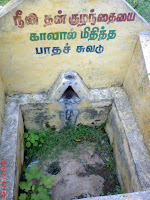 The very site which witnessed this story of courageous village headmen, who kept their promise to uphold their promise and village law, also the place where the Neeli crushed the ghost kid, all are seen still today!
 The very site which witnessed this story of courageous village headmen, who kept their promise to uphold their promise and village law, also the place where the Neeli crushed the ghost kid, all are seen still today!
 A memorial is built in the place where the village head men jumped to death, and was opened for common public by the Chief Justice of Madras High Court! The three kings, Chera, Chola and Pandya have sung in praise of
  this sacrifice, so had sung the mystic poets Sekhizar, Thirugnana
  Sambandar and Umapathi Sivam! So much for keeping up promises, those days!!
In Tamil, there is a hymn sung by the Saint Thirugnanasambandar explaining this story as well as Sekhizaar in his Periya Puranam narrates this story elaborately. This shows the temple is of sangam age.
The tamil quote:-பழையனூர் பேயை நினைத்து திருஞானசம்பந்தர் தம் பதிகத்தில் "முனை நட்பாய் வஞ்சப்படுத்தொருத்தி வாணாள் கொள்ளும் வகைகேட்டு அஞ்சும் பழையனூர்" என்று குறிப்பிடுகிறார். சேக்கிழாரடிகள் தம் நூலில் பழையனூர் நீலி கதையை விரிவாகக் கூறியுள்ளார். 
Also, the three saivaite saints who wanted to worship the Shiva of Thiruvalangadu, stop at Pazhayanur, claiming that it is a sin if they tread on the Thiruvalangadu soil on which Karaikkal Ammayar walked on her head to attain Shiva moksha! This Pazhayanur Kailasanathar temple is in ruins, with trees grown on the vimanam and the stone inscription becoming the stepping stone for the nearby well, tells us the gory nature of the temple. The stone inscriptions you see on your right side, is made as a stepping stone to the temple well! What a bad sight!
Few farming families still visit this temple, as they say it is their  family practice generations together to come to
 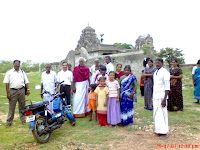 Kailasanathar temple for any occasion.Contributions, toward renovation, can be in the form of DD, Cheque can be sent to REACH FOUNDATION, payable at Chennai.Thanks to member Karthic who had taken the photos shared in this travelogue.
 family practice generations together to come to
  Kailasanathar temple for any occasion.Contributions, toward renovation, can be in the form of DD, Cheque can be sent to REACH FOUNDATION, payable at Chennai.Thanks to member Karthic who had taken the photos shared in this travelogue.
Subscribe to:
Posts (Atom)